// contracts & compliance
How to Negotiate Usage Rights in Influencer Contracts
A brand offers to pay you for an Instagram Reel. You agree a fee, film the content and publish it. Three months later, you see your video running as a paid advert.
Was that included in the original deal? The answer depends on the agreement.
Usage rights define what a brand can do with your content beyond the original deliverable. They're one of the most important commercial terms in a creator contract and one of the easiest to overlook.
Start by separating the post from the licence
A fee for posting on your own channel is not necessarily the same as a fee to license that content for the brand's channels or advertising.
For example, your partnership might include one organic TikTok post. The brand might separately request the right to repost it, use clips on its website or turn it into paid creative.
Those uses have different value and should be agreed explicitly. Ownership of copyright and permission to use a work are separate legal questions so the signed terms matter. In the UK, the creator is generally the first owner of the copyright in their content unless they are employed to make it or have assigned it in writing, so a brand usually needs a licence or an assignment to use it. GOV.UK has a plain-English overview of copyright.
The five usage terms to negotiate
1. Channels and placements
Where can the brand use the content? Specify whether rights cover organic social, brand websites, email, retail screens or paid ads. Avoid treating “digital use” as an adequate description.
2. Duration
Agree when permission starts and ends. A three-month campaign licence is different from permission to reuse the content indefinitely. Ask how the brand will stop advertising when the period expires.
3. Territory
Is the content licensed for the UK, Europe or worldwide use? A local brand campaign and a global advertising campaign aren't automatically equivalent.
4. Paid amplification and creator-account permissions
Running an advert from the brand's account is different from using tools that allow the brand to promote content through the creator's account, often called whitelisting or creator-authorised ads. Specify access, approval controls, duration and whether paid media budgets are limited.
5. Editing and sublicensing
Can the brand crop, subtitle or remix your video? Can it give the content to retailers, agencies or affiliates? Define acceptable edits and whether the brand needs further approval for material changes.
A simple way to price usage rights
Start with the value of creating and publishing the original deliverable. Then assess additional commercial value based on the proposed licence.
Ask how long the brand wants to use the content, where it will appear and whether it can be amplified through advertising. A broad worldwide perpetual paid advertising licence should not be treated as interchangeable with a short organic reposting permission.
There is no universal percentage you must add for usage. The right premium depends on the creator, the campaign and the actual scope.
How CEG prices usage, whitelisting and exclusivity
To make this concrete, here are the uplifts we use in our package builder. They are CEG's working assumptions rather than industry standards, and each one multiplies the base fee for the deliverable.
| Term | Uplift in the CEG package builder |
|---|---|
| Paid usage rights | +25% of the base fee for each month of licence (three months = 1.75×) |
| Whitelisting or creator-authorised ads | +30% of the base fee for each month (three months = 1.9×) |
| Category exclusivity | 1.10× for 2 weeks, 1.32× for 4 weeks, 1.37× for 8 weeks, 1.62× for 13 weeks, 1.80× for 26 weeks, 2.00× for 52 weeks |
For example, a YouTube creator with 100,000 average views and a mid-range lifestyle CPM of £16.50 has a base fee of about £2,640 for a dedicated video (see what influencers charge). Add three months of paid usage and the package builder shows roughly £3,695–£5,545, which is 1.75× the base fee with a 20% range either side.
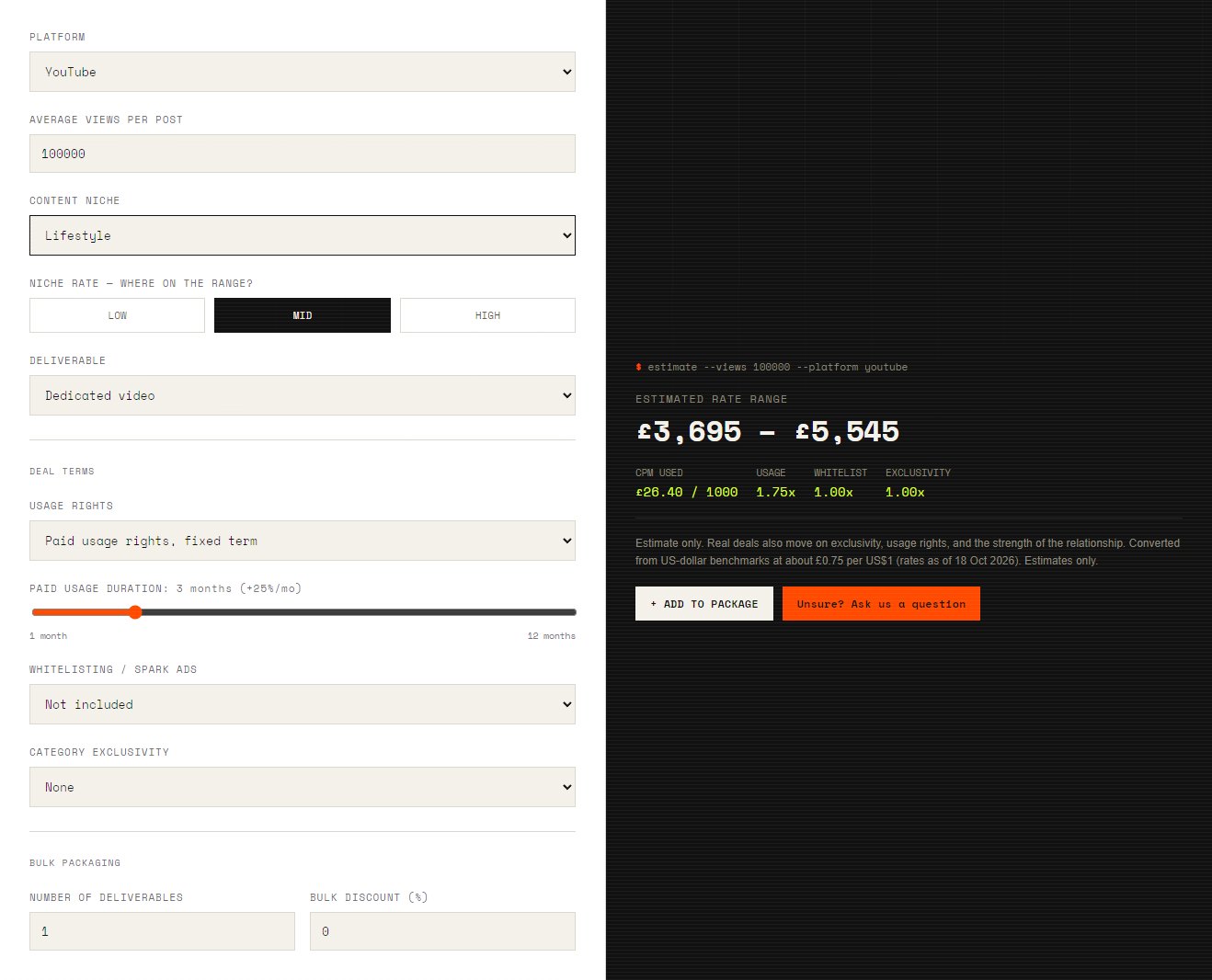
These uplifts combine, so a deal with paid usage, whitelisting and exclusivity grows quickly. That is exactly why each term needs to be priced and written down separately.
What to say when a brand asks for unlimited usage
You don't have to reject the partnership. Try offering a narrower licence that matches the campaign's needs.
For example: “Our fee includes publication on the creator's account. We can discuss a separate three-month paid social licence for the UK and agree an extension if the campaign performs well.”
This keeps the conversation commercial rather than confrontational.
Contract red flags worth checking
Watch for words such as “perpetual”, “irrevocable”, “transferable” and “all media now known or later developed”. These terms are not always inappropriate but they may be broader than you intend.
Also check whether the brand can use your name, likeness and voice independently of the finished content. Ask who is liable for third-party music, graphics or people appearing in the video.
For UK sponsored posts, remember that clear advertising identification is a separate requirement from usage licensing. Review the current guidance from the Advertising Standards Authority, and see our guide to influencer disclosure rules in the UK and US.
Frequently asked questions
Does the brand own content because it paid for it?
Not automatically. Ownership and licensing depend on the applicable law and the contract. Check whether you're assigning copyright or merely granting defined rights.
Can a brand boost my post without asking?
Don't assume it can or can't. Confirm the platform permissions and campaign terms before granting advertising access.
What if the brand wants to extend usage later?
Build in a written extension process with a new fee or a clearly agreed pricing mechanism.
Usage rights checklist: what to agree before you sign
Usage rights aren't small print. They determine how your creative work can generate value after publication.
Define the channels, duration, territory and advertising permissions before you agree the fee. For help navigating creator brand deals, visit CEG, and use our contract checklist before you sign.
This guide is commercial information, not legal advice. Ask a qualified lawyer to review consequential contract terms.
Sources and further reading
Influencer Disclosure Rules: A UK and US Guide for Creators and Brands
How to disclose sponsored content in the UK and US: ASA and CMA rules, FTC guidance, where to put the label, gifted products and a practical checklist.
Influencer Contract Checklist: 12 Things to Check Before You Sign a Brand Deal
An influencer brand deal contract checklist: deliverables, payment terms, usage rights, exclusivity, approvals, cancellation and the red flags to question.
How Much Do Influencers Charge for Brand Deals in 2026?
How much do influencers charge for brand deals in 2026? See CEG's CPM benchmarks by niche, how to calculate your rate and how to price usage rights.