// rates & deals
How Much Do Influencers Charge for Brand Deals in 2026?
How much should you charge for a sponsored post? It's one of the most common questions creators ask and one of the hardest to answer.
The reality is that two creators with the same number of followers can charge completely different amounts. Audience quality, average views, content format and commercial value all influence what a brand is willing to pay.
Whether you're negotiating your first sponsorship or reviewing your existing rates, here's what you need to know about influencer pricing in 2026.
Quick answer: most creators price a sponsorship as average views ÷ 1,000 × a CPM (a price per 1,000 views), then adjust for format, usage rights and exclusivity. In CEG's rate benchmarks, CPMs run from about £5 to £60 per 1,000 views depending on platform and niche. The full table is below.
Why there's no standard influencer rate card
One of the biggest misconceptions about influencer marketing is that creators can be priced according to their follower count.
In reality, two creators with identical audience sizes can command vastly different fees.
Brands consider a combination of factors including average views, audience demographics, engagement, content quality and how effectively a creator can influence purchasing decisions.
There are also significant differences between content formats. A dedicated YouTube video requires a different level of investment from an Instagram Story while a creator producing content for a brand's paid advertising may be providing an entirely different service.
The important question isn't how many followers a creator has. It's what value they can deliver to the brand.
What determines how much an influencer charges?
1. Average views and engagement
Brands increasingly look beyond follower counts to understand how many people actually see and interact with your content.
If you have 100,000 followers but your videos average 8,000 views, brands will evaluate your opportunity differently from a creator consistently reaching 80,000 viewers.
When negotiating, use your average performance across recent comparable content rather than relying on your best-performing viral post.
2. Your audience
Not all audiences have the same commercial value.
A creator with a highly engaged community of UK homeowners could be particularly valuable to a home improvement brand. Similarly, an audience interested in finance or specialist technology may be attractive to businesses selling higher-value products.
What matters is how closely your audience matches the customers a brand wants to reach.
3. Platform and content format
A 15-second Instagram Story shouldn't automatically cost the same as a fully produced YouTube video.
Consider the time required to plan, film and edit the content alongside its expected reach and lifespan.
Long-form YouTube sponsorships can also continue delivering views long after publication, making historical viewing performance particularly important.
4. Usage rights and exclusivity
This is where creators often leave money on the table.
A brand paying you to publish a video on your own account doesn't automatically mean it should be able to use that video in paid advertising for the next 12 months.
Usage rights should specify where the content can appear and for how long. Our guide to negotiating usage rights explains how, and you can price them in our package builder.
Similarly, if a brand asks you not to work with competitors for three months, that restriction has commercial value and should be reflected in your fee.
How to calculate your sponsorship rate
One useful starting point is cost per thousand views, commonly referred to as CPM.
Estimated sponsorship fee = (Average views ÷ 1,000) × Target CPM
For example, imagine your videos average 100,000 views.
| Target CPM | Estimated sponsorship fee |
|---|---|
| £15 | £1,500 |
| £25 | £2,500 |
| £40 | £4,000 |
These are illustrative pricing scenarios rather than fixed industry benchmarks.
Your target CPM will depend on your audience, platform, production requirements and the value of the partnership.
CPM is particularly useful when comparing opportunities but it shouldn't be the only factor determining your rate.
You should also account for any additional deliverables, licensing and exclusivity before sending your final quote.
Not sure what to charge? Try our free Influencer Rate Calculator.
CEG CPM benchmarks by niche
Published rate data is often vague, so here are the CPM ranges we use in our own rate calculator and package builder. They are CEG's working benchmarks, not an industry standard, and they are in pounds per 1,000 views. Our tools are built on US-dollar figures, so we have converted them at about £0.75 per US$1 (rates as of 18 Oct 2026). The calculator shows the same benchmarks in your own currency.
| Niche | YouTube | TikTok | |
|---|---|---|---|
| Finance / Business | £30–£60 (mid £45) | £15–£23 (mid £19) | £21–£42 (mid £32) |
| Tech / SaaS | £23–£45 (mid £34) | £15–£23 (mid £19) | £16–£32 (mid £24) |
| Health / Fitness | £19–£34 (mid £26) | £10–£19 (mid £14) | £14–£24 (mid £19) |
| Education | £15–£30 (mid £23) | £9–£17 (mid £13) | £11–£21 (mid £16) |
| Food & Beverage | £11–£34 (mid £23) | £9–£17 (mid £13) | £8–£24 (mid £16) |
| Beauty | £11–£23 (mid £17) | £8–£15 (mid £11) | £8–£16 (mid £12) |
| Lifestyle | £11–£23 (mid £17) | £8–£15 (mid £11) | £8–£16 (mid £11) |
| Gaming | £8–£19 (mid £14) | £5–£10 (mid £8) | £5–£14 (mid £10) |
| Travel | £8–£19 (mid £14) | £5–£10 (mid £8) | £5–£14 (mid £10) |
| Entertainment / Comedy | £8–£15 (mid £11) | £5–£8 (mid £6) | £5–£11 (mid £8) |
Read the table as a starting range rather than a quote. The low end suits smaller or less proven audiences, mid is a typical benchmark, and the high end suits strong, well-matched audiences with proven results.
The pattern is consistent. Finance and tech sit highest, usually reflecting how valuable a viewer is to the advertiser, while entertainment and gaming sit lowest. In our tables YouTube has the highest CPM in every niche, Instagram is next and TikTok is lowest, with lifestyle at mid-tier the one tie between Instagram and TikTok.
Format matters as much as niche
The CPMs above apply to a standard integration. Dedicated content is priced higher because the brand gets the creator's full attention, so we apply a multiplier to the niche CPM:
| Platform | Dedicated content | Lighter integration | Short-form |
|---|---|---|---|
| YouTube | Dedicated video: 1.6× | Mid-roll integration: 1.0× | Shorts: flat £7.50 CPM |
| TikTok | Dedicated video: 1.0× | Duet or Stitch mention: 0.5× | TikTok Series episode: 0.4× |
| Dedicated Reel: 2.3× | Feed post mention: 1.0× | Story: 0.4× |
Twitch and Kick work differently. Live streams are priced on average concurrent viewers multiplied by hours streamed, because view counts don't apply in the same way.
Worked example: from views to quote
Suppose a lifestyle creator averages 100,000 views on YouTube. The mid-range lifestyle CPM is £16.50. A mid-roll integration (1.0×) at £16.50 per 1,000 views gives a base fee of £1,650, or a range of roughly £1,320–£1,980 once you allow 20% either side. A dedicated video (1.6×) uses an effective CPM of £26.40, a base fee of £2,640 and a range of roughly £2,110–£3,170.
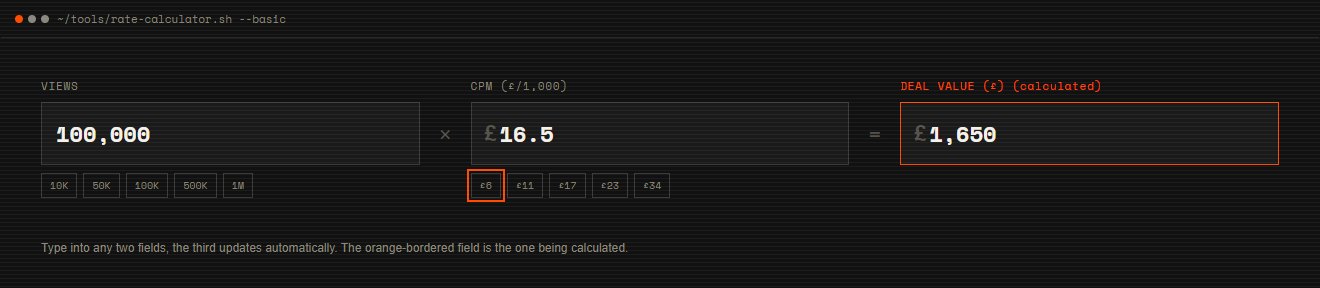
Usage rights, whitelisting and exclusivity then change the price on top of this base. In our package builder, paid usage adds 25% of the base fee for each month of licence, for example. See how we price usage, whitelisting and exclusivity.
Platform by platform
- YouTube: views keep arriving long after publication, which supports higher CPMs. Ask for average views over a longer window rather than the first week.
- TikTok: lower CPMs, so brands often buy several posts or a series. Be clear whether a fee covers one video or a package.
- Instagram: a Reel, a feed post and a Story are very different products. Quote each format separately.
- Twitch and Kick: price on concurrent viewers and stream length, and say whether the deal includes later clips.
Pricing mistakes to avoid
- Quoting from follower count instead of average views.
- Using your best-performing video as your benchmark.
- Forgetting to price usage rights, whitelisting and exclusivity.
- Ignoring production time, revisions and editing.
- Accepting a first offer without asking what the brand's budget is.
Five tips for negotiating better brand deals
1. Understand your numbers. Know your average views, audience demographics and engagement before entering a negotiation. Being able to explain your performance makes it easier to justify your rates, and a good media kit puts those numbers in one place.
2. Ask for the full brief. Before providing a final price, confirm exactly what the brand needs. This includes deliverables, deadlines, revisions, exclusivity and content usage. Our contract checklist covers what to confirm in writing.
3. Price additional rights separately. Paid advertising rights, extended licensing periods and exclusivity shouldn't automatically be included in your standard fee.
4. Negotiate the scope, not just the fee. If a brand has a smaller budget, consider reducing deliverables or shortening the usage period rather than immediately discounting your rate.
5. Think beyond one-off campaigns. Longer-term partnerships can provide more predictable income and stronger integration with your audience. They can also help brands understand your value beyond a single piece of content.
Do influencers need a talent manager to negotiate brand deals?
Not necessarily. Many creators successfully negotiate their own partnerships.
However, as opportunities become more frequent and contracts become more complicated, professional management can help with pricing, negotiations, commercial strategy and protecting your interests. Our guides to what a talent manager does and how much commission they charge explain what to expect.
A good talent manager should contribute more than simply forwarding emails between you and brands.
At Creator Economy Group, we help creators navigate commercial partnerships and develop sustainable businesses around their content.
Frequently asked questions
How much should I charge for my first brand deal?
Start by evaluating the expected reach of your content, the work involved and what the brand is asking for. You don't need a huge audience to justify a fee, particularly if you have a relevant and engaged community.
Should influencers charge extra for usage rights?
Generally, yes. If a brand wants to reuse your content beyond the agreed organic post, the licensing terms and any additional compensation should be established in writing.
Can you earn money with fewer than 10,000 followers?
Absolutely. Smaller creators can attract sponsorships through specialist audiences, strong engagement and high-quality content. Brands may value a relevant niche community more than a larger audience with limited interest in their products.
What to charge for a brand deal in 2026: the short version
There isn't one correct amount to charge for a brand deal in 2026.
The most successful creators understand what their audience is worth, can demonstrate their performance and know how to negotiate the commercial terms of a partnership.
Rather than asking what someone with your follower count should charge, focus on the value you can deliver to a brand and what it costs you to deliver it.
Sources and further reading
- CEG rate calculator CPM benchmarks and format multipliers come from our rate calculator and package builder
- CEG package builder
- ASA: Recognising ads on social media
How to Create an Influencer Media Kit That Brands Actually Use
Learn how to create an influencer media kit with the metrics, examples and information brands need before booking a creator partnership.

What Does a Creator Talent Manager Actually Do?
What does a creator talent manager do? Discover how managers handle brand deals, contracts and long-term growth plus when creators need one.
How Much Commission Do Talent Managers Charge?
How much commission do talent managers charge? Typical flat rates, how CEG charges, what income is covered and the contract clauses to check before you sign.